
Our Theme of a 2003-2007 phase centered on commercial banks takes a step forward
Reference this NFTRH excerpt from July 13th:
Commercial Bank Deregulation Upcoming?
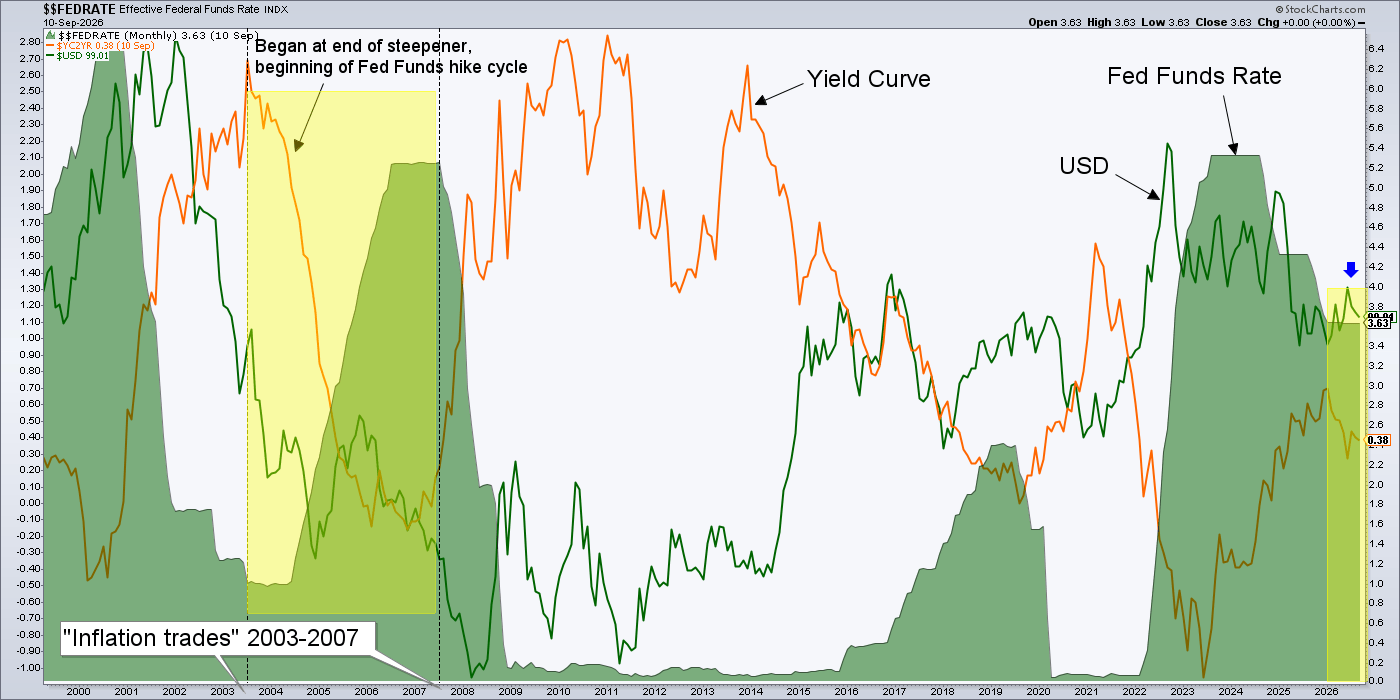
The thesis being that it’s back to the future, 2003-2007 style. Longer-term market people will recall that back then the Greenspan Fed began a rate hike regime, the yield curve flattened, Goldilocks style (it was anything but) and the US dollar tanked.
This set in motion silver’s takeover of leadership from gold, green-lighting a massive broader commodity/resources trade and global market outperformance to US markets.
The chart below shows a comp between then and now.
Today we have an implied rate hike regime with 85% of CME forecasters expecting an FOMC hike next week with gathering momentum for further rate hikes into year-end. This was our thesis beginning 2 months ago.
If the Fed begins a hiking regime, the USD fails and the yield curve continues its 2026 flattening it will be 2003 again, theoretically at least.
Wither Goldilocks?
But Gary, you’ve been going on about Goldilocks a lot lately. Did you temporarily forget your 2003-2007 thesis of an inflationary macro driven by a handoff from Fed policy to the commercial banking sector?
I’m glad you asked. No, I did not forget. I just did not necessarily expect it to engage conveniently soon after the thesis was presented. What I did do was get caught up in the Bessent/Warsh good cop/bad cop routine, allowing for an interim Goldilocks view (complete with and Operation Twist-like yield curve flattening) to/through the mid-term elections in order to paint away inflation signals.
In short, I gave a lot of credit to Bessent and a would-be Goldilocks situation in the short-term situation. But maybe a lot of the heavy policy lifting is actually being done by the Warsh Fed, as per the post linked near the top, illustrating that while Warsh may be able to hold the line on a hawkish Fed monetary stance, the commercial banking complex will take over the heavy economic lifting from here.
Warsh + Banks, Not So Much Warsh + Bessent?
After this week’s inflation data and Fed projections showing a rate hike all but given, and seeing the market’s positive reaction today, Friday, I reevaluate the timing. Could it perhaps be 2003 already, here and now? If the chart above starts to show a breakdown in USD and a continued flattening of the curve, the 2003-2007 plan would engage, assuming Warsh does stay hawkish.
On Friday, post-CPI, USD looks none too stellar below resistance and the 200 day moving average, despite news that is firming the Fed hawk view. For an interim Goldilocks scenario, this week’s data and its hawkish Fed implications should be USD-positive. But that is not the case.
The market already knows that the Fed is going to kick off a rate hike regime.
If the buck were to sell the news and dump, it would increase the odds that the market would buy the news. It would also put another important feature of the 2003-2007 comp chart at top in play.

After all, USD is in a massive bear market. Charts don’t lie. Lower lows and lower highs.

What lurks within the current data, within the market’s psyche that could be staving off a widespread market retreat? Again, the only thing that makes sense beyond the short-term is the 2003-2007 scenario of a commercial bank led economy while the Fed abdicates its market micromanagement.
This is a more honest and healthy way of running an economy. Real companies practicing commerce within a more real economy, rather than a centrally managed interest rate manipulation department (cue the Fed’s meeting of economic eggheads).
But there are problems with the coming phase.
Problem #1
$40T+ debt overhang produced over the years of heavy bank regulation and Federal Reserve omnipotence, especially during Ben Bernanke’s tenure. QE, Op-Twist, MMT… it all added up to TMM, total market manipulation through remote management. Dangerous leverage is a huge issue.
Problem #2
Even without the monstrous debt overhang of today, the 2003-2007 phase ended in disaster. A deflationary liquidation that could only be stopped by Ben, the “hero” Bernanke and off-the-charts debt-leverage. That previous phase, also known as Greenspan’s Credit Bubble and driven by unfettered greed and unlimited risk taken by the banks was like child’s play compared to the risk hard-wired into today’s situation.
Bottom Line
The handoff to the commercial banks should eventually help, or at least change the way economic business is done. But again, that debt overhang. There is also the little detail of how the ’03-’07 phase ended. In an utter deflationary whirlpool. Until Bernanke really cranked up the Fed-centric manipulation.
You see how circular this mess is. Of course you do. It’s a new secular cycle with new methods. But as long as credit is unconstrained and debt expands in some form or other, it’s not a long-term solution. It may just feel that way for an extended period. Eh, boys?

Back on the here and now, it is just one data rich day in a data rich week. Markets popped a bit. It’s notable, given the supposedly USD-positive headlines. But next week the goons will meet and there is always a lot of energy in the air during FOMC week.
Soon, however, we should know if it’s the start of (1) a 2003-2007 style big bull trade in precious metals (led by silver), commodities and global markets. Or if it is indeed (2) an interim Goldilocks (if USD firms), or (3) flat out failure sooner rather than later, likely including a strong USD and Gold/Silver ratio.
I give better odds to options 1 and 2 than option 3. But that is one man’s opinion in a dynamic situation that is in transition.
I am admittedly a little all over the place. But that is sometimes required to eventually come out on top of a fluid and complicated situation. Once we have our macro playbook for the months and perhaps even few years ahead, we will be able to “top-down” it into positioning correctly for it. I expect that to be for a global “inflation trade”, 2003-2007 style. But there are other, less pleasant possibilities.
For “best of breed” top-down macro analysis and market strategy covering Precious Metals, Commodities, Stocks and much more, subscribe to NFTRH Premium, which includes a comprehensive weekly market report, detailed NFTRH+ updates and chart/trade setup ideas, and Daily Market Notes. Receive actionable (free) public content at NFTRH.com and subscribe to our free Substack.

Excellent observations. Looking forward for the weekly.